


Retirement is, ironically, complicated.
It seems simple enough from the outside looking in: you stop working and still have money available to live the life you want. However, given how the economy, workplace and health landscape have changed this past decade, the path to, and definition of, retirement has become more complicated.
Which is perhaps why you’re reading this.
While you’re earning income from work and looking ahead and planning to a life without work, you can control certain factors.
In my opinion, first and foremost, saving and investing thoughtfully for the future remains critically important. You have control over what you spend, put away, invest, and how you allocate your investments into various asset classes. As financial advisors, we can guide you with both. We help you plan and develop an investment strategy and portfolio unique to your circumstances and goals, with the objective of minimizing portfolio volatility and maximizing returns over time for future income streams once you stop working.
As you gain clarity and take steps toward retirement, certain questions tend to arise:
First, would you continue to work after you have the option to retire, and why? Because while not impossible, it could be difficult to go back once you stop.
And second, what does well-being in retirement entail once you make that decision?
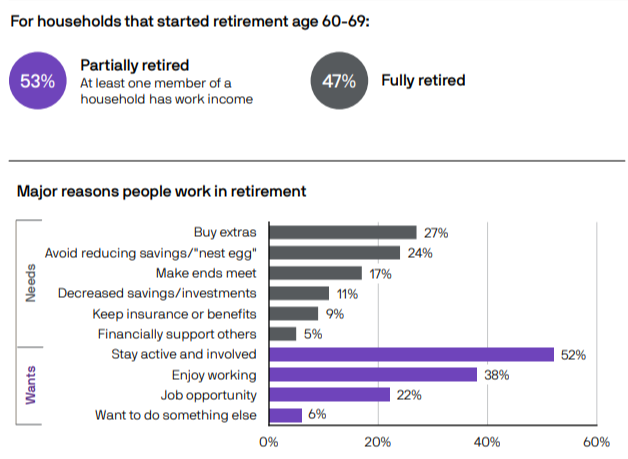
These days for households of people who start some version of retirement in their sixties, 53% are actually only partially retired, meaning at least one member of the household has some income from work. They continue to work for a variety of reasons: some are compelled because they feel a need to do so for insurance, extra luxuries, and to continue saving. Others do so to stay active and involved, and because work continues to be enjoyable and satisfyingi. Essentially, the definition of retirement is quickly changing from what it was just a generation ago, and approaching retirement has begun to mean keeping work as a positive option for yourself.
Once you do decide to fully step away from work, what’s the point of retirement, and more importantly how do you maintain your wellbeing once you wind down and fully stop working? I dare to ask, what’s the point of having all the newly freed up time?
There are three distinct but interrelated pillars to the newly freed-up time that retirement providesii:
- Finding and maintaining purpose in your day without work.
- Socialization – Having a community: being with friends, former colleagues, family
- Health – stay active, stay healthy
I believe you must work hard (!) to fulfill all three, with each requiring commitment and effort. If just one of these pillars' wanes, all the free time and income you’ve earned from decades of work and savings can become less meaningful, and life in retirement loses its luster.
Whether you decide to fully retire or continue to work and earn in some fashion, you must determine and pursue purpose each day, be around people you enjoy, and take care of your health. All the money in the world can’t do the work for you to keep these three pillars robust and balanced. Keep these in mind in your plans for your future.
So, remember:
- Do everything you can to save and invest strategically for the long-term.
- Strongly consider continuing to work in some fashion after a point that you could indeed retire.
- Define beforehand what retirement means for you and set expectations for yourself.
- Commit to the three pillars of retirement well-being and work hard to maintain their integrity and balance.
i https://am.jpmorgan.com/content/dam/jpm-am-aem/global/en/insights/retirement-insights/guide-to-retirement-us.pdf | page 7 ii Ibid | page 8