


By Matthew Sweeney, Managing Partner at William Joseph Capital Management Inc.
Inspired by a recent report in The Wall Street Journal¹
Global trade dynamics are shifting dramatically. In 2023, governments worldwide implemented over 3,000 new trade restrictions—an unprecedented pace that reflects a significant move toward economic nationalism and strategic recalibration. Nations are increasingly deploying tariffs, export bans, and other trade measures to protect key domestic industries and safeguard national security amid mounting geopolitical tensions and supply chain vulnerabilities.
A Surge of New Trade Barriers
Recent data show that this wave of trade restrictions is not merely about protecting local industries but also a response to broader geopolitical uncertainties. Countries are rethinking their dependencies and focusing on sectors deemed critical for technological supremacy and national resilience—such as semiconductors, vaccines, and essential minerals. This trend marks a departure from the long-established post–World War II multilateral trading system toward a more fragmented and strategic use of trade policy.
Historically, trade wars have served as a tool for securing national interests. During the mercantilist era, European nations used tariffs and colonial monopolies to amass wealth and maintain economic dominance. The Anglo-Dutch Wars, marked by intense naval confrontations over lucrative trade routes, serve as early examples of how trade conflicts can reshape international power dynamics.
Lessons from the Past
Economic barriers have deep historical roots. During the Napoleonic Wars, Napoleon Bonaparte's Continental System (1806–1814) sought to weaken Britain by banning trade with it. Although intended to cripple British economic power, the blockade had significant unintended consequences—disrupting trade across Europe and impacting neutral states. This episode underscored the double-edged nature of economic coercion: while it can be a powerful tool against adversaries, it can also inflict widespread collateral damage.
Similarly, the Smoot-Hawley Tariff Act of 1930 in the United States serves as a stark reminder of the risks of aggressive protectionism. Enacted during the Great Depression, the act raised tariffs on over 20,000 imported goods, triggering retaliatory measures from other nations. This spiral of protectionism deepened the economic downturn, illustrating how such policies can backfire and exacerbate crises.
The Modern Landscape: Targeted Measures in a Fragmented World
Today’s trade wars differ from historical examples in both focus and execution. Instead of broad, economy-wide measures, modern restrictions are highly targeted. Governments now hone in on specific sectors crucial to national security and technological leadership.
For instance, the United States and the European Union have introduced aggressive subsidies and support programs for semiconductor manufacturing and clean energy projects. These measures aim to bolster domestic capabilities in high-stakes industries, yet have sparked disputes even among traditional allies. Simultaneously, major economies such as China and India are imposing export restrictions on critical resources like rare earth minerals and essential agricultural products to secure robust domestic supply chains.
This multifaceted approach can be described as “a trade war by a thousand cuts”—a series of sector-specific measures that, while individually modest, collectively have a substantial impact on global trade.
Visualizing the Shift: U.S. Tariff Trends
A key tool in understanding these shifts is the “Tariff Turnaround” chart, which illustrates the evolution of U.S. average tariff rates over time:
• Early 20th Century (circa 1902): U.S. tariffs peaked at approximately 27.8%, indicative of an era marked by high protectionism.
• 1930s (Smoot-Hawley Era): A dramatic rise in tariffs during this period contributed to economic strain during the Great Depression.
• Post–World War II: The establishment of multilateral institutions such as the General Agreement on Tariffs and Trade (GATT) and later the World Trade Organization (WTO) led to a significant reduction in tariffs, fueling expansive international trade.
• Recent Years: The latest surge in average tariffs—initially seen during the Trump administration and persisting today—reflects a renewed emphasis on safeguarding domestic industries.
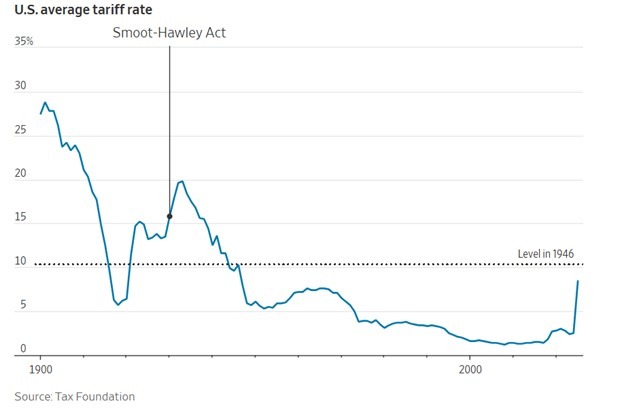
Chart Credit: The Wall Street Journal / Tax Foundation
Economic and Geopolitical Implications
The implications of these new trade restrictions are profound. Economists warn that the cumulative effect of fragmented, targeted measures could stifle global economic growth and innovation. The International Monetary Fund estimates that persistent trade fragmentation might reduce global GDP by more than 7% over the long term².
For consumers, the immediate consequences often include higher prices and reduced availability of certain goods. For businesses, the impact is felt through disrupted supply chains, increased regulatory uncertainty, and potentially reduced investment in critical technologies. More broadly, the erosion of trust between trading partners complicates efforts to negotiate cooperative agreements in areas like climate change and international security.
The geopolitical landscape is also being reshaped. Economic policy is increasingly viewed through the lens of national security, with countries prioritizing supply chain resilience and strategic autonomy over the efficiency benefits of global integration. In this new paradigm, economic measures serve not only to protect domestic industries but also to assert national strength in a competitive global arena.
Navigating a Complex Future
Policymakers today face a daunting challenge: balancing the need to protect national interests with the long-term benefits of global cooperation. While targeted trade restrictions may address short-term vulnerabilities, a sustainable path forward requires policies that support both domestic innovation and international collaboration.
Potential strategies for the future include:
• Investing in Domestic Innovation: By bolstering research and development, countries can reduce reliance on foreign technologies while remaining competitive globally.
• Diversifying Supply Chains: Rather than decoupling completely from international partners, nations can diversify their sources of critical goods to mitigate risks associated with overdependence.
• Strengthening Multilateral Institutions: Reinforcing organizations like the WTO can help mediate disputes and maintain a rules-based trading system, even as countries pursue more targeted protectionist measures.
Striking the right balance is crucial. Excessive protectionism can lead to retaliatory measures and a downward spiral of economic isolation, while unbridled globalization may leave nations vulnerable to external shocks and strategic manipulation.
Concluding Thoughts
The current surge in trade restrictions marks a turning point in global economic policy. While tariffs and trade barriers have long been used to pursue national interests, today's measures are distinguished by their targeted approach and deep interconnection with broader geopolitical concerns. The lessons of the past—from mercantilist practices to the Smoot-Hawley experience—remind us that protectionism, if left unchecked, can trigger retaliation, disrupt global stability, and ultimately hinder economic growth.
As we navigate this evolving landscape, it is essential for policymakers, business leaders, and economic stakeholders to develop strategies that strike the right balance between national security and global cooperation. By embracing policies that foster both innovation and resilience, we can build a more sustainable and prosperous economic future—one where the benefits of a connected global marketplace are preserved while critical domestic interests are effectively safeguarded.
________________________________________
Disclosure:
The views expressed in this article are those of the author and do not constitute investment advice or recommendations by William Joseph Capital Management Inc. This material is for informational and educational purposes only.
________________________________________
Bibliography
1. Hayashi, Yuka. “Trade War Explodes Across World at Pace Not Seen in Decades.” The Wall Street Journal, March 2025. Link
2. International Monetary Fund. “Geo-Economic Fragmentation and the Future of Multilateralism.” IMF Staff Discussion Note, January 2023.